

THE LAST BATTLE FOR NARNIA
I held my breath as I mentally prepared to watch The Magician’s Nephew trailer with a mix of apprehension blended with hope. By the end of the trailer however, I struggled to process what I’d just seen. Two parts glam rock psychedelia, one part Narnia, a half cup of Wonkavision, and a dash of Austin Powers. All of these taken individually, possess their own merits, but I don’t want any of those things in Narnia. For the past 70 years, they’ve simply not existed there, and no one has missed them.
Some ingredients, while amazing on their own, are a bad combination. Take Oscar the Grouch. His favorite sandwich consisted of peanut butter, pickles, and anchovies. Each of these ingredients on their own are tasty, but trapped together they create garbage – which is what Oscar loves – but he lives in a trash can.
Narnia lives behind a magical wardrobe.
And that’s all I’ve ever needed it to do.
ALWAYS WINTER
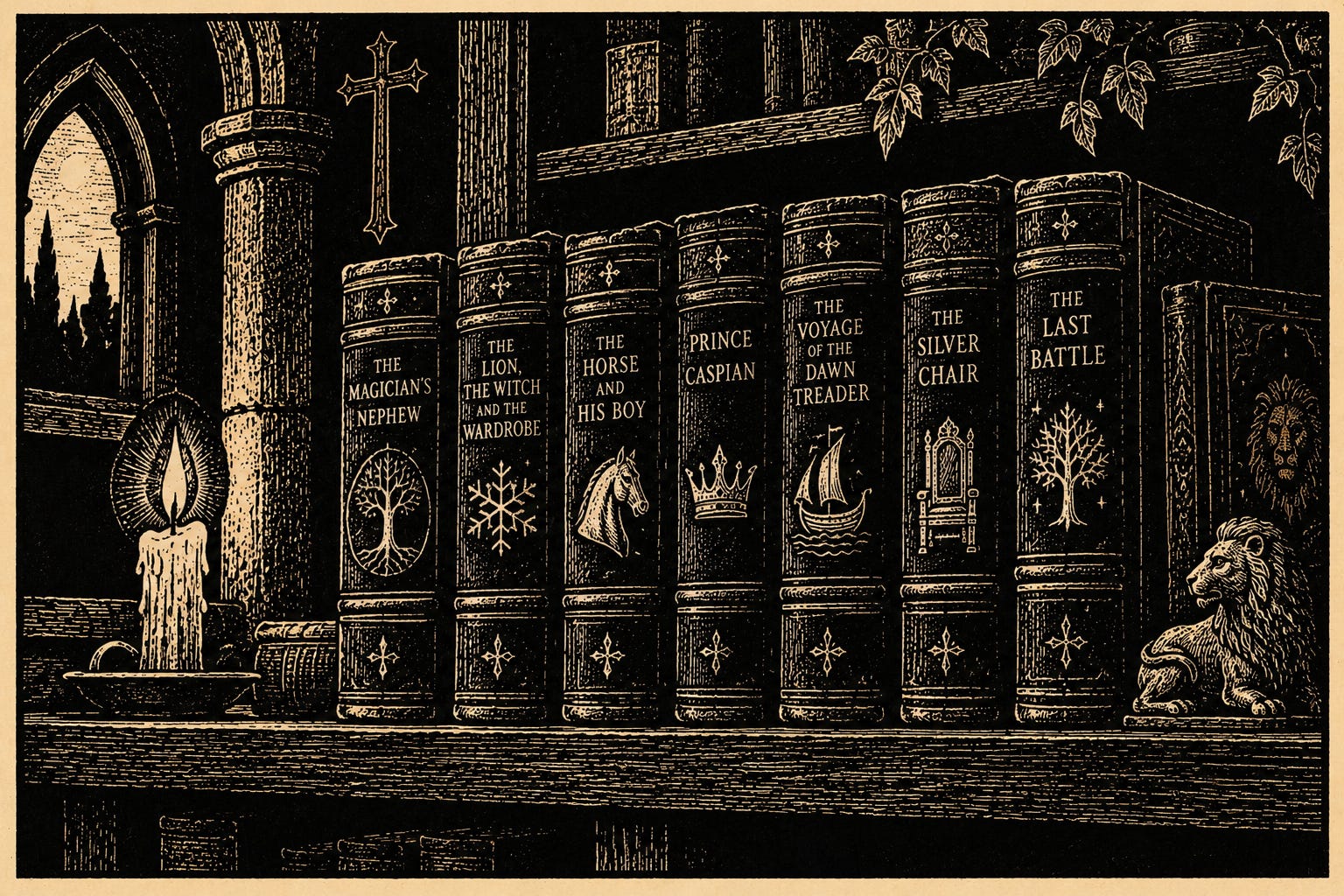
I’ve owned The Chronicles of Narnia on Audible for years. Yet, last week after the trailer, but without warning, the cover was redesigned to promote Greta Gerwig’s forthcoming Narnia adaptation. I found myself staring at the title in my library, wondering when exactly I’d agreed to have my books visually rebranded. It felt forced upon me like the White Witch’s reign, covering the Narnia I loved with a film of what she preferred. Always winter, never Christmas.
It was a subtle action, but one that pinpointed what I couldn’t put into words after watching the trailer – that the movie was attempting to reinterpret the books rather than the books shaping the film – the reinterpretation nobody asked for. It also illustrated perfectly what my concerns with the films are. When it comes to such a classic work of fiction, there should never be a two-way swinging door. The door of creativity should swing outward from the book towards the film itself. Never the opposite. For the original work is the source - the adaptation is derivative.
An author creates the world, while the filmmaker is merely invited to enter it. Gerwig should have entered it with the awe and wonder of the Pevensies, seeking to understand it—rather than entering with the same presuppositions that Uncle Andrew, the Magician himself did. When Andrew enters Narnia, he can’t hear the animals speaking because of his underlying assumptions about the world are too ingrained. Able to enter Narnia, but unable to experience it.
To prevent the filmmaker from spreading this disease, they must understand their task. The quest should not be to correct the author’s imagination, but to faithfully translate it into another medium. Gerwig’s vision therefore, should never blanket Lewis’s artistic vision with her own white snow, no matter how much of a wonderland she thinks she’s creating. And the problem is only compounded when the publisher follows suit, adopting the filmmaker’s aesthetic to overwrite the original work’s visual identity. Something has gone terribly wrong. In just thirty seconds of footage, Gerwig has demonstrated that she has failed in her primary task—a faithful aesthetic translation of the author’s vision. Worse still, the keepers of the tomes, entrusted with preserving Lewis’s legacy, have abandoned their post. Or at least let the door swing back the wrong way.
For film making from a book, is, in short, much like animating a still frame. Lewis’s works locked Narnia in place for us. All Greta Gerwig needs do is animate the pictures that Lewis already painted for us with his pen. But when a film maker fails to understand they’ve been entrusted to animate someone else’s vision, they risk redrawing the art itself.
And Lewis surely didn’t need a filmmaker to invent Narnia’s atmosphere. It already had a magical environment all its own.
The lamppost glowing in the snow.
The wardrobe opening into another world.
The terrifying beauty of Aslan.
What Lewis penned, we could see in our imaginations. And what our imaginations delivered, we could feel. Peter Jackson understood this, and recruited Alan Lee, and John Howe, the two greatest Tolkien artists who somehow captured the universal pathos in paint. The problem was that when we saw Greta Gerwig’s vision – we just didn’t feel it. We expected to see Lewis’s Narnia come to life, but instead, we glimpsed the World of Grarnia.
Imagine standing in front of Rembrandt’s masterpiece, The Return of the Prodigal Son, loved and adored for centuries - the father bending over his broken son, communicating grace, forgiveness, and the feeling of coming home surrendered and defeated. Now imagine someone approaching the painting with a brush and deciding it needs updating for the modern age. Perhaps the father could use the lightning-bolt makeup from Aladdin Sane across his face. Maybe the prodigal could wear the Austin Powers velvet suit. And to tie it all together, a Willy Wonka color palette would do the trick. It would certainly be creative. Surely get marks for being original. But would it enhance the Rembrandt? Not in the slightest. It would destroy the artists original vision – and there’s certainly no reason to do it to Narnia.
UNDERSTANDING NARNIA
Narnia is too well established, and too universally loved to endure what Gerwig is attempting. Disney learned about the power of Narnia’s popularity when its 2005 The Lion, the Witch, and the Wardrobe became one of the biggest block-busters that year. The studio understood the balance it needed to strike between reaching a bigger audience while appealing to the Christians that championed the books.
Narnia is a unique IP, much like Tolkien’s Middle-earth embedded with a deeply anchored theological framework. To disturb these ancient boundary stones is unwise. Nor can someone simply rearrange the furniture to accomplish some theatrical feng-shui without expecting a blowback of consequences.
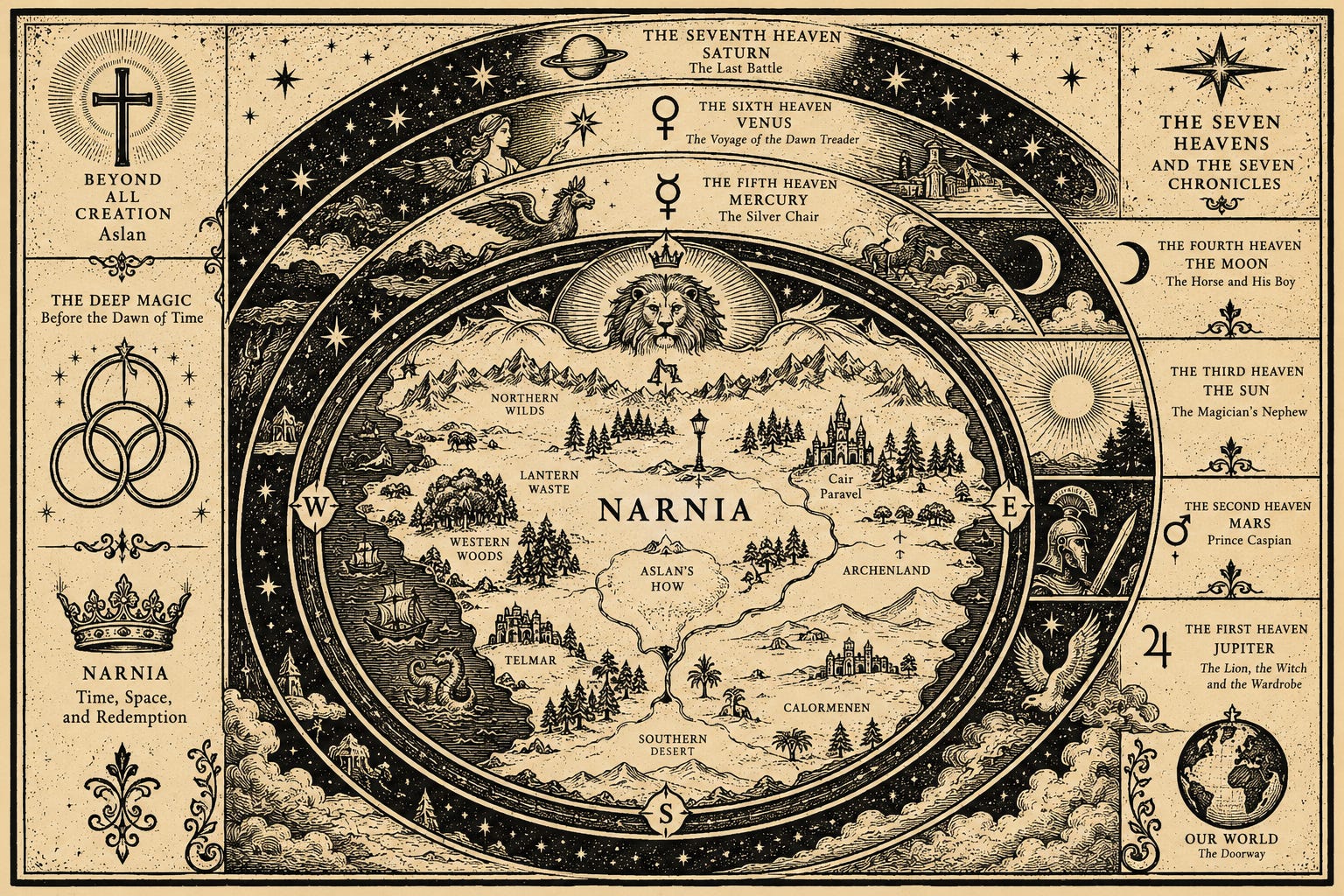
For example, In Planet Narnia: The Seven Heavens in the Imagination of C. S. Lewis, Michael Ward demonstrates how the seven Chronicles correspond to the seven heavens of medieval cosmology. Jupiter, Mars, the Sun, the Moon, Mercury, Venus, and Saturn each provide the governing atmosphere of a particular book. The Silver Chair is the Moon. Prince Caspian corresponds with Mars. Ward argues that the planetary imagery shapes everything from the atmosphere and narrative structure to how Aslan reveals himself in each title. It is generally accepted by scholars who study Lewis, that he wasn’t simply constructing a fantasy world, but crafting a sophisticated imaginative architecture, much of which remained hidden from his readers for decades. It has only been through studying his letters, and other works that scholars have been able to piece it together. For those who haven’t taken the time to understand the deep magic of Narnia, pulling Jenga blocks to accommodate modern sensibilities risks collapsing the entire structure.
Yet behind Lewis’s fluid pen, there was an intentionality to challenge himself to use pagan imagery (one of his great loves in literature) to communicate Christian themes. In many ways, it served as the litmus test to his own mind of whether his imagination had been truly baptized and therefore transformed.
An understanding of these things should make it evident that the IP of Narnia is not like that of Star Wars. In creating his world, Lucas blended religious, philosophical and mythological influences into one creative synthesis, like Lewis, but Narnia attempted something further. Lewis employed fantasy - even paganism - to illuminate eternal truths; what Aslan called “the deeper magic before the dawn of time”. Lewis desired to craft an imaginative doorway through which a reader could step through, like a wardrobe, to encounter Christ unaware. Spiritual truth, as unfashionable in his day as it is in ours, was made visible, through a talking lion.
We must be careful here, because Lewis stated that Aslan himself was not a metaphor for Christ, but a supposal.Supposing that there was another world, and suppose Christ entered that world as a lion – another type of incarnation – what might happen? This is the link to everything in the Chronicles. Therefore, Aslan’s identity is not incidental to the story, but rather essential.
But therein lay the rub. Can those who don’t personally know and love Aslan, and what he represents in reality, truly understand Narnia? This is a question Lewis teases out repeatedly in the Chronicles. There is an illustration of the inability to understand Narnia apart from knowing Aslan. It is found in book four of the Chronicles, The Horse and His Boy. In it, the Caloremenes, to the South East of Narnia, know of Narnia, yet fail to understand it. They have strange views about its nature - a primitive land ruled by demons and terrific beasts that eat men. The tragedy is that the Caloremenes judged Narnia by the assumptions of their own world - their understanding distorted by their own culture, fears, and prejudices. Perhaps Lewis was warning about the very dangers that come with a modern adaptation that attempts to explain Narnia without understanding Aslan. Modern audiences, like the Caloremenes may know all about the Narnian land to the North – they just don’t know its king. And if you lose the king, you lose Narnia.
He is the key of what holds Narnia together. Therefore, an attempt to modernize Narnia to make it relevant, fails to connect with what has made it timeless. Narnia has survived for generations precisely because it doesn’t belong to any single generation, or the fads of the time it was written. Narnia’s underlying theology was as unpopular then as it is now. Yet it appealed to the masses – because it represented something eternal.
This is precisely why the online ridicule of Christians being “mad about Cat Jesus” so easily misses the wood for the trees. Aslan is scandalous because he IS “Cat Jesus”. Merely another imagined form of the incarnation. A talking lion is not what anyone expected, as scandalously absurd to us as a crucified, peasant rabbi was to his peers. The people who ridiculed Jesus of Nazareth are the same reincarnated characters ridiculing the supposed incarnation in the form of a Lion. As apostle Paul wrote in 1 Corinthians 2:14, “The person without the Spirit does not accept the things that come from the Spirit of God but considers them foolishness and cannot understand them because they are discerned only through the Spirit.”
This does not mean that someone must be a Christian to enjoy Narnia, however. Quite the opposite. Lewis hoped his stories would awaken spiritual longings in his readers, who might never have considered Christianity. You can appreciate Narnia’s beauty without recognizing its King, but that is not the danger facing Narnia. The danger is that someone who doesn’t understand the King assumes the authority to redefine his kingdom.
ANOTHER WORLD
Perhaps Greta Gerwig has missed Narnia for Grarnia precisely because she’s envisioning a different Aslan than the rest of us. The first image of Aslan, released to tease the film, portrayed Aslan as made of cloth. A kind of Velveteen lion. The two different colored eyes of Greta’s Aslan are a tribute to David Bowie. And love Bowie as a I do, he has nothing to do with Aslan, nor do I want Aslan portrayed like a mere performer, legendary as he was.
What Gerwig is striving for, and can’t seem to grasp, is what Lewis penned so well in crafting the character of Narnia – an elusive sense of holiness. Aslan can’t be nailed down. He can’t be caged. He can’t be fully explained, nor is he in the books. And that mystery is part of his majesty.
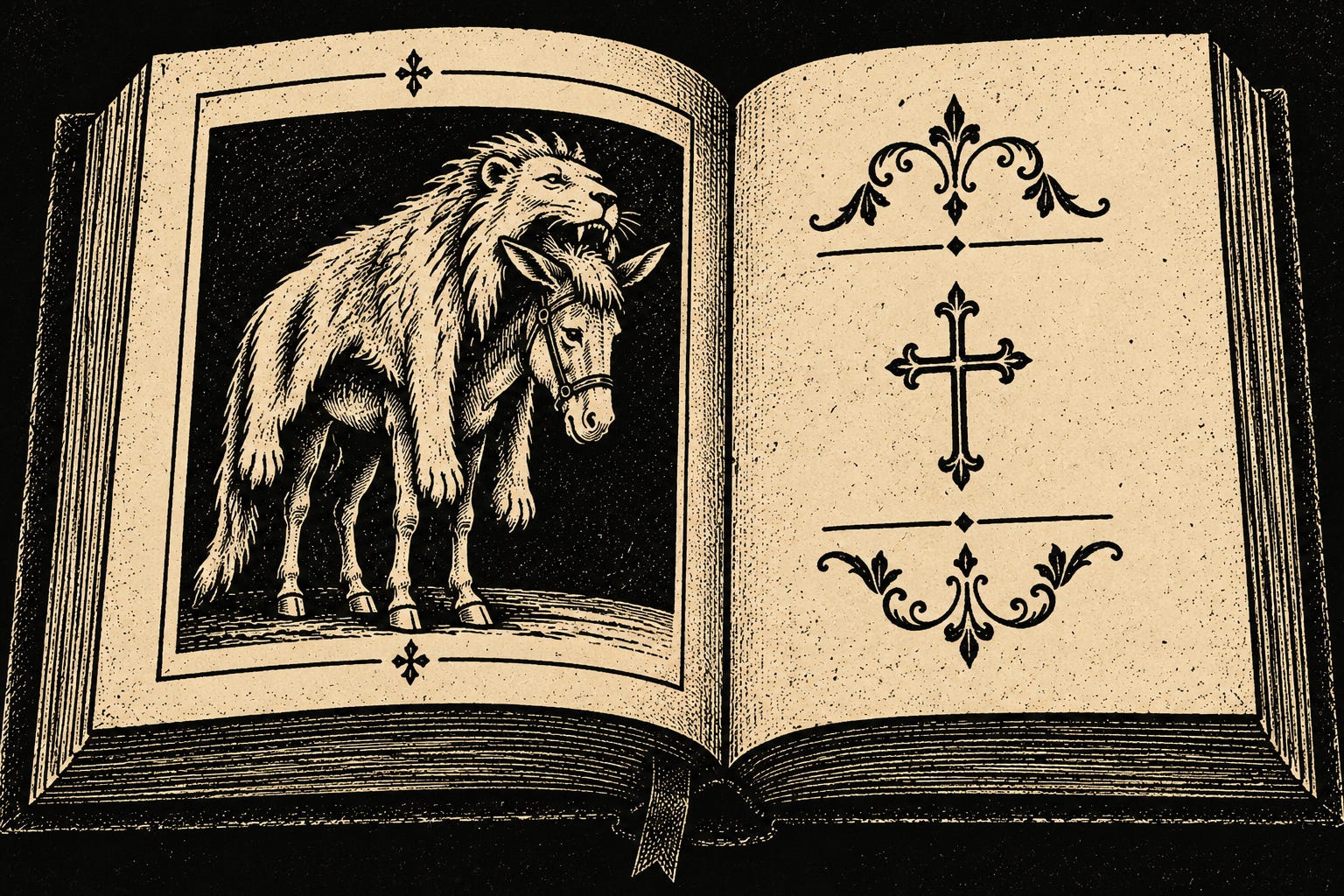
But what has puzzled so many Narnian readers is the rather obvious comparison her reimagining of Aslan invites. In The Last Battle, Lewis’s final Chronicle, Shift the Ape discovers a lion skin and persuades Puzzle the Donkey to wear it. He then presents this counterfeit Aslan to the Narnians, insisting that they accept his manufactured version of the Lion as the real thing. Those who question the substitution are manipulated into silence. The irony is beyond perfect, because here we are, seventy years later, debating what Aslan is supposed to look and sound like. One would think that anyone attempting to reinvent the Lion might have anticipated the comparison.
The backlash started with the decision to cast Meryl Streep as the voice of Aslan. The objection isn’t to Streep herself who is, beyond dispute, a legendary actress. Rather, the controversy arises from the identity of the character she’s been asked to portray. Aslan is not simply a talking lion whose voice can be reinvented without consequence. To Lewis, Aslan is unmistakably male. For readers who understand that Christological connection, it raises questions about whether the filmmakers understand the theological significance of the character they’ve inherited. Whatever Gerwig’s intentions, the casting risks appearing less like a faithful interpretation of Lewis and more like an attempt to reshape his creation according to contemporary sensibilities. It’s a case where the ideological tail appears to be wagging the lion.
THE HUBRIS OF THE AGE
In the age of social media, rife with TikTok wisdom, the abundance of ones opinions on a subject often outweigh ones knowledge of it. Anyone with a knowledge of Lewis would understand his disdain for critics injecting their thoughts into the works of authors who are now dead. As a professor of Medieval studies at Cambridge, Lewis had much to say about this. His challenge was to teach his students the importance of approaching ancient literature through the world view of the writer, so that they could properly learn from them. Too often, Lewis observed what he coined “chronological snobbery” – the view that anything old, or ancient needed correcting by moderns. Highlighting humanity’s tendency to wink and smirk at the ignorance in the wisdom communicated by generations past, Lewis challenged that those who went before us might be in more of a position to teach us, than to be lectured to.
In his introduction to Athanasius’s On the Incarnation, Lewis recommended reading an old book between every new one. The reason was simple: every generation has its own characteristic cultural blind spots, and the best way to recognize our own is to listen to people who did not share them. Old books are not necessarily wiser than new ones, but they are wonderfully free from the assumptions that we mistake for common sense. As the old saying goes, the fish is the last one to notice the water.
Unfortunately, this generation places themselves in the position to teach, without ever taking the seat to learn. And Lewis, like Tolkien has much to teach this age of ignorance and moral ambiguity. We approach ancient works as though they were students in need of correction, standing over their shoulders with a red pen rather than sitting at their feet. And this is what Gerwig has appeared to approach Lewis without realizing it.
Yet, Lewis understood something that our generation seems determined to forget. You can reproduce the wardrobe – one that leads to nowhere. You can reproduce the snow, the talking animals, and the magic in CGI, yet miss Narnia completely. Narnia already has a creator. It wasn’t looking for another.
And so we are left with questions. Will this wardrobe lead to Narnia? Or somewhere else?
It will only be answered by how the film makers answered the underlying question: Who gets to define Narnia? The author who created it, or the generation that controls the camera? If the author owns the pen, and a director owns the camera, then in a game of Rock, Paper, Scissors, my money is on the pen being mightier than the camera.
Perhaps the greatest irony is that Lewis already wrote a story about what happens when someone manufactures a new Aslan and insists that everyone else accept the substitution. He called it The Last Battle.
This was not the first battle for Narnia, it’s just the latest, and it certainly won’t be the last.
- Peyton Jones
So much interesting
So, well stated! A reinterpretation no one asked for.